

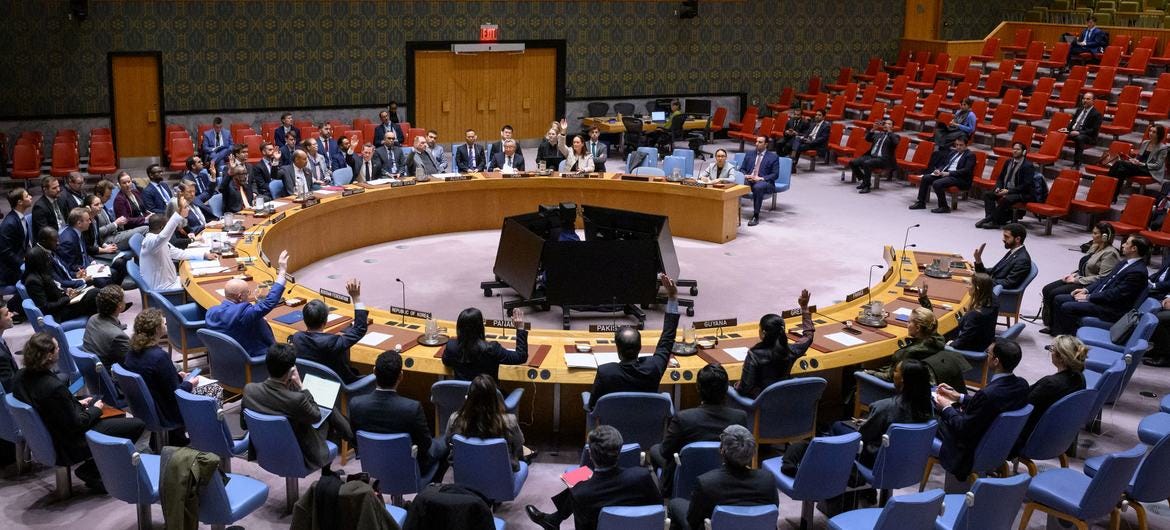
In a landmark move on November 6, the UN Security Council passed a resolution lifting sanctions on Syria’s President Ahmad Sharaa. The measure — driven primarily by the United States after months of coordination within the P7 — follows the Trump administration’s earlier decision to lift most U.S. sanctions on Syria.
While the resolution does not remove Syria from its designation as a State Sponsor of Terrorism, it represents a clear step toward the country’s gradual reintegration into the international community. The decision eases travel restrictions on Syria’s president, allowing him to travel abroad without requiring formal UN approval — a symbolic but significant shift in Damascus’s diplomatic standing.
[See my timeline of the China-Syria political dialogue here]
China, however, does not share Washington’s enthusiasm.
For months, Beijing has engaged with Syrian authorities through a pragmatic, security-focused lens on the ongoing presence of Chinese Islamist fighters — particularly members of the Eastern Turkistan Islamic Movement (ETIM) — in Syria. Many of these fighters, according to multiple UN member states, have since been integrated into Syria’s Ministry of Defense. As Washington pushed for sanctions relief, Beijing had a narrowing window to secure a bilateral understanding on counter-terrorism before a vote was called.
No baseline
It does not seem that the two sides reached an established baseline, but the conversation is ongoing with Syria’s Foreign Minister set to visit China this month. The lack of baseline did, however, force Beijing with an uncomfortable choice at the vote: cast a lone veto and risk diplomatic isolation, or abstain and signal reluctant acquiescence.
The resolution was also rare moment of conensus around Syria, with Russia supporting the resolution. China was the one exception. Beijing, in principle, rarely votes against a concencus, and Russia’s support for the resolution meant China would be the only holdout once a resolution was tabled.
Judging by China’s UN Representative’s statements, China’s decision to abstain was out of pressure, not breakthrough. In other words, China would not cast the only veto.
This is the scenario I highlighted in a previous analysis:
“If Russia or the Gulf Cooperation Council countries are willing to agree to lift UN sanctions on Syria, it is likely they may try to bring China along. Beijing will not want to be seen as blocking consensus in the international community.” (Full piece here)
The Chinese representative emphasized at the vote that China’s concerns had been repeatedly raised during consultations (with member countries), particularly regarding foreign terrorist fighters. He accused the resolution’s sponsors — implicitly the U.S. and its partners — of forcing a premature vote to “serve their own political agenda,” while failing to account for the “legitimate concerns of all parties.”
For China, the ball is now in Syria’s court to see how it will respond to the ongoing presence of Eastern Turkistani Islamic Movement (ETIM) foreign fighters in Syria.
Despite China’s concerns with ETIM in Syria, other council members do not seem to share China’s concern, per UN Sanctions Committee minutes from July 2025:
“One Member State reported that ETIM/TIP has kidnapped, harassed and intimidated Chinese civilians in the Syrian Arab Republic. One Member State assessed that the primary allegiance of ETIM/TIP was to the new Government of the Syrian Arab Republic. Another Member State said that members had been integrated into Syrian society and were employees of the Ministry of Defence of the Syrian Arab Republic.”
This raises critical questions about where the Sino-Syria relationship goes next. China’s core concerns in Syria remain security and predictability. Beijing wants some form of assurance that Syrian authorities will prevent the reorganization or movement of foreign fighters, but its remaining leverage following the UN resolution vote is its participation in reconstruction.
China is unlikely to move forward on participating in rebuilding at scale without demonstrable steps that restrict these networks and clearly delineate their status inside the Syrian state. Syria stands to benefit from Chinese infrastructure investments and reconstruction support, but that support is not going to come until their is a mutual agreement on the way forward.
UN Representive Fu Cong full comments at the UNSC meeting following the vote:
“China has been consistently committed to developing friendly relations with the entire population of Syria, respecting the choice of the Syrian people regarding the future and destiny of their country and supporting the international community in helping Syria to swiftly restore peace and stability so that the Syrian people can soon live in dignity. Regarding adjustments to the Security Council’s sanctions related to Syria, China’s position has been loud and clear from the very outset.
We are of the view that the Security Council should give full consideration to the counter-terrorism and 06/11/2025 Threats to international peace and security caused by terrorist acts S/PV.10036 25-30211 3/8 security situation in Syria, the complex potential implications that the adjustments may entail and the long-term interests and actual needs of Syria so as to properly address the legitimate concerns of all parties and make prudent decisions based on careful study. Regrettably, the resolution that was just put to a vote (resolution 2799 (2025)) failed to reflect those principles and that spirit. China therefore had to abstain.
Over a period of time, Council members held multiple rounds of consultations on the resolution. Out of a sense of responsibility towards Syria and the Syrian people, China actively participated in the consultations. Together with many members, we expressed legitimate concerns about counter-terrorism issues, in particular the presence of foreign terrorist fighters in Syria, and put forward many constructive proposals for amendments. However, the sponsor did not fully heed the views of all members and forced the Council to take action despite the huge differences of opinion among Council members, in an attempt to serve its own political agenda. China expresses its regret about this.
At present, Syria is undergoing a political transition, while facing a fragile security situation and the arduous task of counter-terrorism efforts. Large numbers of foreign terrorist fighters have exploited the situation to their advantage, seriously threatening Syrian, regional and international peace and security. The fight against terrorism is fundamental to Syria’s national reconstruction. Any action taken by the Council on Syria should fully consider the counter-terrorism situation and contribute to achieving the Council’s objectives on counter-terrorism. Any support and assistance provided to Syria should not undermine the integrity and effectiveness of the Council’s sanctions regime. The resolution just adopted reaffirms the Council’s counter-terrorism requirements and makes it clear that Syria should fulfil its commitments in this regard, take decisive actions to combat terrorist acts and respond to the threat of foreign terrorist fighters, which include the Eastern Turkistan Islamic Movement (ETIM) in Syria. In this regard, the interim Government in Syria should fulfil its counter-terrorism obligations, take practical measures to make substantive progress and win the trust of the international community.
At present, more than 80 entities and more than 250 individuals are still on the Council’s sanctions list under resolution 1267 (1999), and such measures as travel bans, assets freezes and arms embargoes are still in effect. All countries are obligated to uphold the authority of the Council, strictly implement the Council’s sanctions and resolutions and prevent all organizations, entities and individuals, including ETIM, from directly or indirectly obtaining funds, weapons and other types of support from outside, posing a threat to the security of other countries.
The evolving situation in Syria, as an important country in the Middle East, affects regional peace and stability. It is necessary for the Council to pay close attention to the situation in Syria and to take the necessary actions in a timely manner, according to how the situation evolves, to push the situation in Syria to move in the right direction. China stands ready to work with the international community to continue to play a constructive role in achieving security, stability and development in Syria at an early date.