

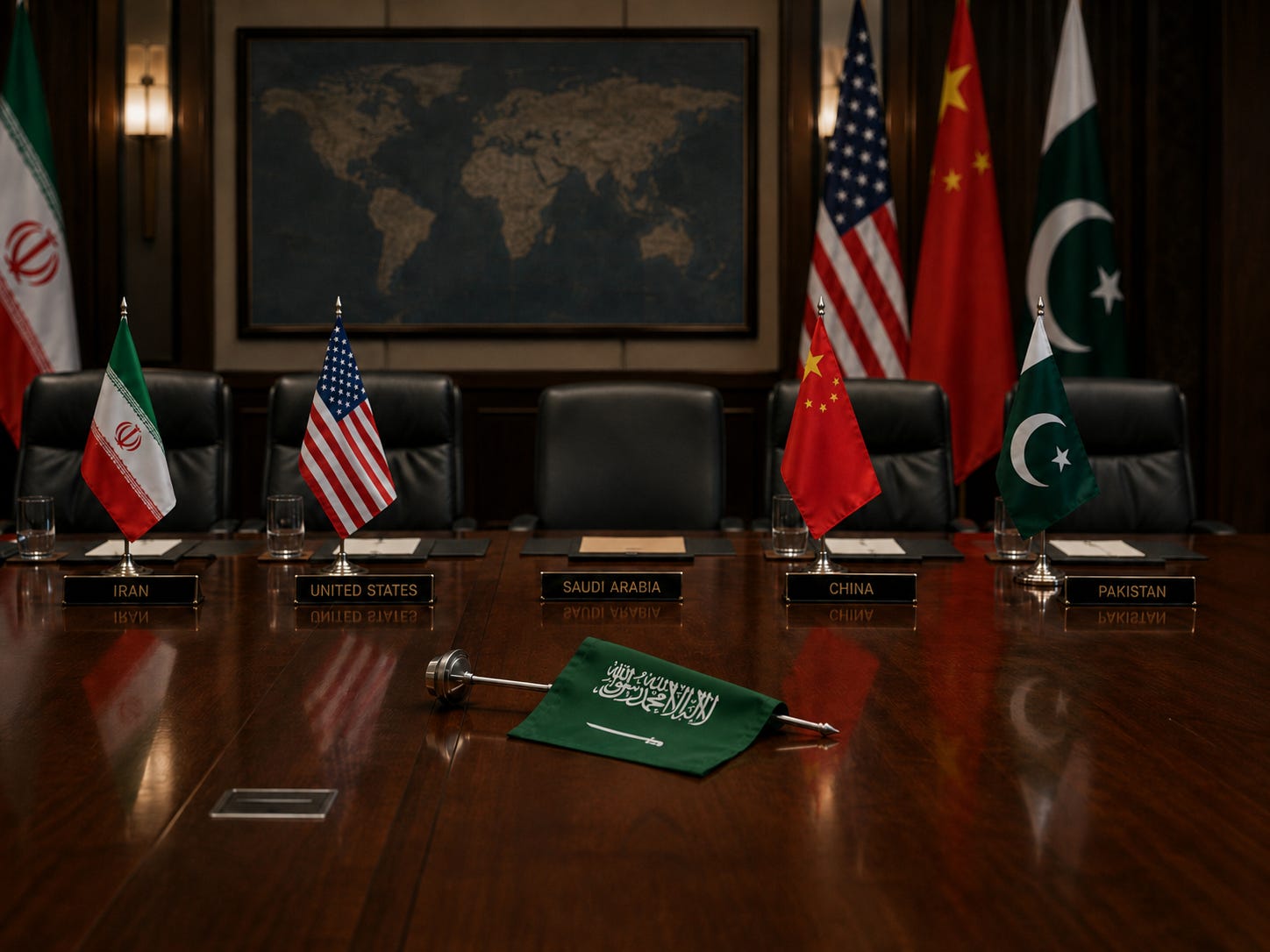
This is my first long-form piece in some time. I encourage you to read it in full, as it covers a wide breadth of the history of the Iran deal (and how the Gulf were excluded), how that shaped the trajectory of the region, why it is happening again, and what the future of the region looks like if the “right” deal is not reached. Sadly, in many cases, a “right deal” is too far beyond the scope of acceptable terms Iran and the US would accept. The key takeaway of this paper is simple: Trump has followed Obama’s example and sidelined the Arab Gulf states from the table determining their future security.
Trump has announced (again) that both sides are nearing a deal. Trump consulted (or at least notified) his Arab counterparts in the Gulf that both sides are nearing an outcome. From what we know of the evidence, Trump is not going to be able to secure a better deal than the 2015 Iran deal, at least with regard to nuclear outcomes. And, Iran will likely emerge with a larger stake in control over the Straits of Hormuz and a war-proven offensive, capable missile and drone stockpile. I will not belabor the debate over who won and who lost or what it means for global order. There is certainly enough of that type of analysis proliferating on Substack and in think tanks. Instead, I want to hone in on one feature of the current deal process which seems disturbingly familiar to Gulf audiences. They were not invited to the table again. During Obama’s administration, the stakes were high, but the Gulf was not under attack. During Trump administration, the GCC states have taken the brunt of Iran’s attacks (especially the UAE), despite not playing any major role in the conflict.
The Original Sin
For the GCC, Iran has been and remains the prevailing external regional security threat. The Gulf states primarily feared a nuclear Iran. They also feared that the Obama administration would use a nuclear deal with Iran as an exit strategy from the Middle East. Despite these concerns, the P-5 countries (the US, UK France, Russia, China, and Germany) signed JCPOA with Iran in 2015. This marked the first major diplomatic breakthrough on the Iran file and outlined an agreed-upon framework for lifting sanctions on Iran in exchange for verifiable limits on its nuclear program.
For Gulf monarchies, the JCPOA process was a point of deep disappointment and frustration. From its inception, the GCC was excluded from negotiations and was not aligned with the Obama administration in their security expectations. The collapse of trust began in July 2012, when Jake Sullivan, then Secretary of State Hillary Clinton’s deputy chief of staff, and White House Iran advisor Puneet Talwar slipped into Muscat for preparatory bilateral meetings with Iranian officials, facilitated by Sultan Qaboos, without notification to the Gulf. The channel deepened in March 2013, when Obama personally authorized Deputy Secretary of State William Burns to lead a full delegation to Oman, days after the stalled P5+1 round in Almaty. Four additional clandestine sessions followed Rouhani’s election in August 2013, producing much of the architecture of the November 2013 Joint Plan of Action. Gulf governments learned of the backchannel only when the Associated Press broke the story. The subsequent Gulf exclusion from the P5+1 process damaged diplomatic ties with the Obama administration and contributed to the growing perception among Gulf allies of the unreliability of U.S. security guarantees.
Obama finally engaged GCC leaders after the Lausanne framework was finalized at the Camp David summit in May 2015. Here, the Obama Administration tried to get the GCC on board with the new deal by leveraging U.S. military hardware to secure Gulf alignment with the new deal. Only two of the six Gulf leaders attended the summit, which was widely interpreted as a snub to the White House. Saudi King Salman, along with the leaders of Bahrain, Oman, and the United Arab Emirates, declined to attend; only the emirs of Kuwait and Qatar accepted Obama’s invitation. The UAE delegation, led by Ambassador Yousef Al Otaiba, pressed for a formal written security guarantee in place of the longstanding “gentleman’s agreement” with Washington, a request the joint statement declined to meet, offering instead fast-tracked arms transfers and a vague new strategic partnership framework.
Gulf anxieties were reinforced when Obama later argued that the Saudis must learn to “share” the Middle East with Iran and framed Gulf security as a “free rider” problem, not a core American interest. This was received by some Gulf leaders as a direct criticism, and Saudi’s Prince Turki bin Faisal issued a sharp reply days later in Arab News publicly condemning Obama’s “free rider” assertion.
Critics of the Iran deal saw it as a concession. From their view, the Obama administration negotiated with the principal regional adversary without addressing many of their core concerns, including Iran’s ballistic missile program, support for proxy forces across the region, or its broader destabilizing behavior. The deal did address the nuclear threat, but even this Gulf states believed to be too narrow. It only delayed, not dismantled, Iran’s nuclear infrastructure and allowed over $100 billion in unfrozen assets to flow back to Iran, the Iranian Revolutionary Guard Corps, and regional Iranian proxies actively threatening Gulf security and regional stability.
The Obama team tried the same play twice. Jake Sullivan, who opened the original backchannel, returned as Biden’s National Security Advisor and spent four years attempting to revive the JCPOA framework Trump had abandoned in 2018. The Vienna talks of 2021 and 2022 ran through eight rounds of indirect negotiation, mediated again by European intermediaries, structured again around the nuclear scope and sanctions relief, and were conducted again without Gulf participation at the table. Saudi Arabia, the UAE, Bahrain, Qatar, Oman, and Kuwait received briefings and reassurances from White House officials, but the substantive negotiation excluded them. This snub, in addition to the harsh rhetoric from the White House, especially toward Saudi Arabia was one of the drivers of the GCC’s China hedge, accelerated the GCC’s engagement with Beijing. Intensive regional mediation by Oman and Iraq culminated in the March 2023 Chinese-brokered normalization between Saudi Arabia and Iran. Washington has little to no role. The Vienna track ultimately collapsed without an agreement.
If you ask Obama and Biden-era officials, they will provide a logical argument for why the Gulf was not included in the initial rounds. Wendy Sherman, the lead U.S. negotiator on the JCPOA, has framed it as a Gulf preference. “When we began the negotiations,” she recalled, “the Gulf said, just make sure you only focus on nuclear issues because if you’re going to discuss regional issues, we need to be in the room.” Obama, in his own accounts, offered a harsher critique telling the The Atlantic, that the Saudi’s must learn to ‘share’ the Middle East with Iran, and Gulf security was a “free rider” problem rather than a core American interest.
Is Past Prologue?
Trump built his 2017 presidential bid on the claim that Obama fumbled the talks and allowed Iran to strengthen itself. Now Trump appears to be fumbling those same talks, but Iran’s structural gains this time around are exponentially larger than before. Trump may claim that Hezbollah has been “defeated” by Israel. Israel’s war in Gaza, following Hamas’ brutal attacks on October 7th, largely decimated Hamas’ capacity, but Israel leveled Gaza and forced millions of Palestinians into inhuman conditions. Israel and the U.S. have now fought two wars against Iran in two years, and Iran, while severely weakened, has advanced new forms of asymmetric warfare by weaponizing interdependence. The region is no better off. Israel is not safer. Iran is less restrained and rationally waging new forms of economic warfare. The United States is not more powerful. Trump’s voter base is worse off, facing rising prices and new economic hardship.
Most troubling among all of these developments, from the Gulf perspective, is that Trump’s war, which they advocated against, has wrought havoc on them with little to no gain. The Gulf states are, arguably, worse off in terms of the security standoff with Iran, who showed its willingness to inflict harm on the GCC in retaliation for U.S. war efforts. This means a deal that freezes the current reality can be construed as a loss for the Gulf states. The Gulf states want a deal because the economic costs of a protracted war are more damaging than a new status quo. But a new status quo where Iran has successfully bombed the Gulf states and gained advantage from it is a hard reality for the Gulf states to stomach.
For all that Trump’s war has cost the Gulf, the President is now biting from the same fruit the Obama administration enjoyed in 2012. Trump has again excluded the Gulf states from the talks. This time, the Trump administration cannot hide behind an excuse of the talks being exclusively nuclear, because the priority objectives are entirely regional. Every aspect of these deals shapes the Gulf states’ future.
The irony of this entire scenario is that the GCC is the only bloc well-positioned to actually play the role of bridge builder, since they can engage with Israel, Iran, China, Russia, and the United States. Lest we forget, Saudi Arabia was the only GCC state able to reach a sustainable peace with Iran following the Oman-Iraq brokered mediation and China-brokered normalization. Iran may run to China for legitimacy, but it will not get the support it wants from Beijing. The U.S.-Israel complex position on Iran makes their negotiating position a constant sliding scale that is deeply unreliable and, at times, prone to the use of violence. The GCC are still the only countries willing to engage with every actor, even the ones who have bombed them.
That is a degree of restraint which, for any state currently being bombed by its neighbor, is incomprehensible. I spoke with a Chinese scholar recently who told me it was the duty of Gulf states to show restraint and not retaliate against Iran. I asked if one of China’s neighbors bombed China, whether he would argue that Beijing’s duty was restraint rather than self-defense. What was most baffling was the assumption that Iran has a right to self-defense, and the Gulf states did not.
I raise this because Gulf restraint is logical and rational, and it earns them a greater role in deciding the future of the Persian Gulf.
Consider how the other actors behave during negotiations. Iran, Israel, and the US routinely “escalate to de-escalate,” a pejorative term which basically means they try to increase the harm they inflict on the other in hopes of gaining more in the negotiations. This is generally accepted as the status quo of negotiations. What if the Gulf states decided they did not like the current Iran deal negotiations and instead chose to “escalate to de-escalate” by attacking Iran to undermine it? For most observers, this is an unthinkable scenario because it flies in the face of Gulf interests and risks their broader strategic environment. Yet somehow it has become expected that their duty is self-restraint rather than self-defense. Strategically choosing self-restraint is a state’s choice. Viewing it as a state’s responsibility is diametrically opposed to how political scientists and IR scholars think about state interests.
This is not a case for the Gulf states to attack Iran. In fact, the Gulf’s strategic restraint has been the right path. It is, however, a watershed moment of reckoning for the Gulf states about their own agency, strategic autonomy, and right to self-defense. If the lesson Iran takes away from this war is that harming Gulf states is a legitimate form of deterrence, this puts the Gulf into a worse state of insecurity long-term. It is a future scenario that each Gulf state has to evaluate individually and as a unit.
So, where does Trump’s new deal leave the GCC? Is the United States negotiating for its own interests, Israel’s, or the GCC’s? Is there a version in which all three are possible? If not, how do Trump and his advisors plan to reach a “winnable” deal for the United States? That answer is the one that keeps many in the region awake at night.
Trump could end the war, shift his focus to China, and leave a broken region behind. This would subject the entire region to an existential security dilemma and spark a brutal competition for influence across states with weak governance. We have already seen this bloody cycle play out in Yemen, Syria, Iraq, and Lebanon. For Gulf states, the return of proxy warfare, regime change, and civil war undermines their long-term economic objectives and creates an existential threat to the monarchies. It also underscores the logic of building defensive and military capabilities to pre-empt the worst outcomes and deter future wars like the current one. This sets the stage for Israel, Iran, and the Gulf states, especially Saudi Arabia and the UAE, to build their capabilities simultaneously. It is a slippery slope to an arms race, and one in which two actors, Iran and Israel, have shown more willingness to use their offensive capabilities than the Arab bloc.
The emerging KSA-UAE split suggests that a unified GCC framework to address this potential outcome may be difficult to reach. Saudi Arabia may lean into a security framework with Turkiye, Pakistan, and Egypt. The UAE appears to be leaning into its relationship with Israel. This creates a regional alignment problem for states like Jordan, Syria, and Lebanon, which see growing tensions with Israel as a larger threat than Iran. Saudi Arabia plays a large role in Syria and Jordan, and sees the Israeli expansionism in Syria, Lebanon, Gaza, and the West Bank as a growing threat to regional stability. The UAE is also involved in Syria and Jordan, but it is not yet clear how its relationship with Israel will shape its other regional partnerships.
Give them a seat at the table
I conclude this depressing evaluation of the region with one potential near-term way out: the GCC must be included in the negotiations.
The Gulf states are the only actors in this conflict with credibility on every side of the table. Some have brokered with Iran. Some have normalized with Israel. They maintain working channels with Beijing, Moscow, and Washington. They have absorbed Iranian strikes without retaliating. They have funded reconstruction in places the United States walked away from. No other bloc carries this combination of access, restraint, and regional stake.
A deal that excludes them or their concerns will not hold. The JCPOA collapsed in part because the states most affected by Iranian regional behavior had no seat at the table (and advocated for the rise of a president who would consider their interests). The Vienna track collapsed for the same reason. A Trump-era deal that repeats the architecture will produce the same outcome on a shorter timeline. The patience which guides Gulf restraint is not infinite.
Thank you for reading. Reach out if you want to chat further.