

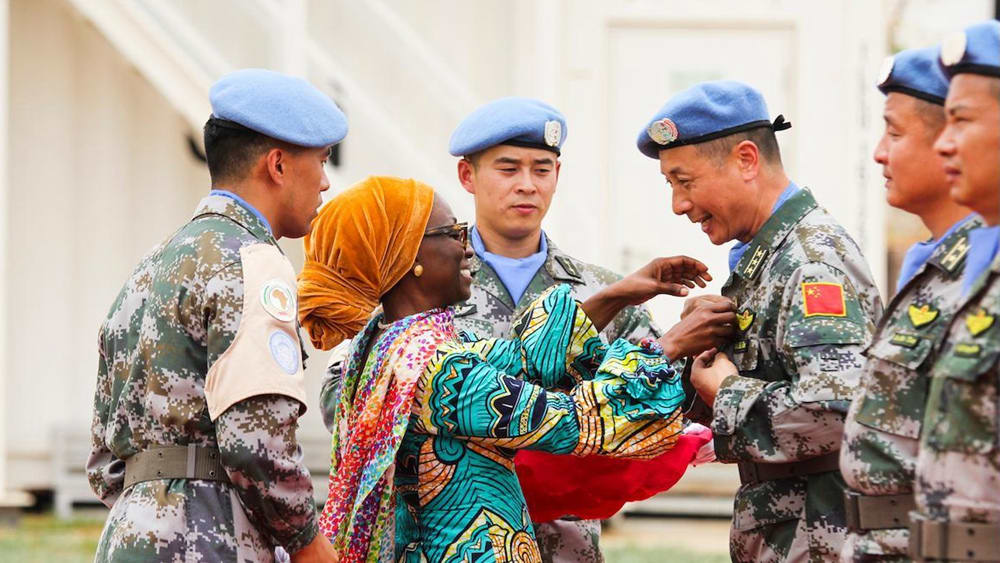
Chinese peacekeepers once played a critical role in Darfur, but now Beijing is keeping Sudan at an arms length to avoid entanglement.
China has a long and troubled history in Sudan. It clouded Beijing’s 2008 olympics after mass public criticism tied China’s vast energy investments to the state-backed genocide in Darfur. The less discussed part of this history, which also demands some further research was Hu Jintao’s quiet diplomatic push on Omar Bashir to end the same genocide in Darfur over fears that failure to do so would prompt western intervention.
[For more background on China’s 2003-2010 engagement around Darfur, see here]
Fast forward to the current conflict, China’s response to Sudan’s war has been far removed from its previous engagement. From day one, Beijing was clear: stop the shooting, restart a political track to get governance back on track, and keep outside powers from turning Sudan into a proxy arena. Sadly, all three of these have, so far, failed to create any real traction, and China has kept the entire Sudan conflict at an arms reach to avoid getting more deeply entangled. That said, Beijing has maintained a strong rhetorical position on the need to reach a negotiated settlement and end the conflict.
China’s response to the Sudan conflict
When the war broke out in April 2023, the Chinese foreign ministry publicly called for an immediate ceasefire and a transition process, warning that outside interference had deepened the turmoil and put regional investment, especially its own investments at risk. Words were followed by hard logistics. Acting on top-level instructions, Chinese authorities executed a 15-day, multi-route evacuation dubbed “a long journey home” (万里归途) moving more than 1,500 Chinese nationals out of Sudan by bus, naval frigate, and chartered aircraft, and assisting 231 citizens from eight other countries. The official after-action tally—1,508 citizens evacuated and support to third-country nationals—was later summarized alongside nearly twenty similar operations in the past decade. This period underscored China’s improved crisis playbook, combining consular protection, military lift, and whole-of-government coordination to get civilians out of harms way.
At the United Nations, China shifted its rhetoric from a generic call for de-escalation to a more explicit call for support for African-led mediation and the use of narrowly scoped Council tools. In March 2024, China urged a Ramadan ceasefire and compliance with Resolution 2724, pressed for tighter UN coordination with the African Union and IGAD, and cautioned against politicizing aid delivery. By September 2024, Beijing backed renewing the UN arms embargo as a limited tool to reduce violence, and stressed that sanctions must serve—not replace—the political track or erode Sudan’s sovereignty. In December 2024, China called on the Council to “create conditions” for a proper resolution and welcomed closer coordination among the UN, AU, IGAD, and the Arab League, while highlighting tangible relief: food and medical deliveries, a grain shipment, and a joint FAO farming initiative. When the RSF advanced again in October 2025 on Al Fasher, China condemned attacks on civilians and hospitals, restated three priorities—stop the war, scale humanitarian access, and push talks—and reaffirmed support for African solutions while rejecting parallel authorities or imposed formulas that would fracture the state.
The View Inside China
Policy thinkers inside China track this line while debating the timing and modality for any Chinese mediation. In June 2023, a Taihe Institute analysis argued that Sudan risks a Syria- or Libya-style collapse with terrorist spillovers if left unchecked, recommended strict neutrality and opposition to interference and sanctions, and—if U.S.–Saudi channels stall and regional actors invite it—proposed co-hosting talks with Egypt and Saudi Arabia in Beijing, using “劝和促谈” (patient persuasion) rather than coercion. Another policy observer reported that Sudanese elites may trust a Chinese-supported channel more than Western pressure politics, but warned China’s leverage is limited and any form of entanglement should wait until the violence slows.
Chinese academics have also mapped the risk picture that makes China both stakeholder and cautious facilitator. At an April 2024 roundtable marking one year of fighting, Chinese scholars underscored the nationwide stalemate between the RSF and Sudanese Armed Forces, the expanding transnational fighter flows, and growing spillovers across the country. Participants argued for sustained evacuation readiness and for close coordination with African and Arab partners to protect core stakes—oil, infrastructure, and Belt and Road nodes—without breaching non-interference norms.
A separate analysis highlighted concrete risks to Chinese assets—including oil fields and pipelines, plus flagship infrastructure from the Merowe Dam to the new Khartoum airport—now in limbo as a result of the war. While officials frequently signal willingness to work with whichever authority holds Khartoum, Chinese officials see little value in getting more deeply engaged, making any further political commitments to Sudan, or trying to restart its economic footprint. Why? Because Beijing’s fear of proxy warfare in Sudan became a reality—only not from the West as initially assumed. Middle Eastern states’ interests and rivalries in Sudan, many with close ties to China, have become primary drivers of the conflict.
Will China get more involved?
After last weeks brutal images of RSF violence against civilians in Al-Fasher, the Trump Administration has taken a more assertive role in brokering a ceasefire. If they are unsuccessful, It seems unlikely that Beijing will get involved in Sudan without a regional invitation. Beijing’s posture remains conservative. It will not assume responsibility unless several conditions converge: (1) there is a regional request for mediation, (2) a “more-than-half-baked” framework between the RSF and SAF produces a minimal freeze in frontline violence with AU/IGAD firmly in the lead, and (3) there is a credible prospect of a high-visibility win for China.
Any Chinese involvement would also likely depend on Cairo, Riyadh, and Abu Dhabi sharing ownership and enforcement in a shared framework like the Jeddah Dialogue. So far, there seems little incentive from those backing warring parties to come to the table, and getting them to do so would likely require a degree of international pressure and coercion which China would be unlikely to assert, especially if it meant pressure on Arab states with interests in Sudan.
It hinges on the Arab states
The competition among Arab states with interests in Sudan sustains the conflict. Any viable settlement ultimately hinges on those states agreeing to end the war, then putting pressure downward on the warring parties they back to align. There is little incentive for warring parties to agree to a ceasefire or engage in substantive negotiations if their international backers cannot reach a concensus.
Furthmore, at a time where Arab states are rhetorically looking to de-escalate regional tensions in conflicts with Israel and Iran (where they do not control all of the levers), they are failing to resolve Sudan, which, arguably, is fully in their power to stop. Most, if not all, of the levers of influence over the armed groups—financing, aid, arms flows, political cover, access—sit with them. Failure to use them to end the war is a question of interest and political will, not capacity.